Identity and sequence
Confirms material matches the intended payload.
Technical discussionProgram-specific method and result not presented; define and verify per program.
An approach to connecting decisions on payload, composition, process, quality and transfer in the design of each mRNA product system.
NM-mRNA is Driessen-Kerr's approach to integrating payload, composition, process, stability and transfer in mRNA product systems. An architecture designed for consistent technical decisions and broad-reach applications.
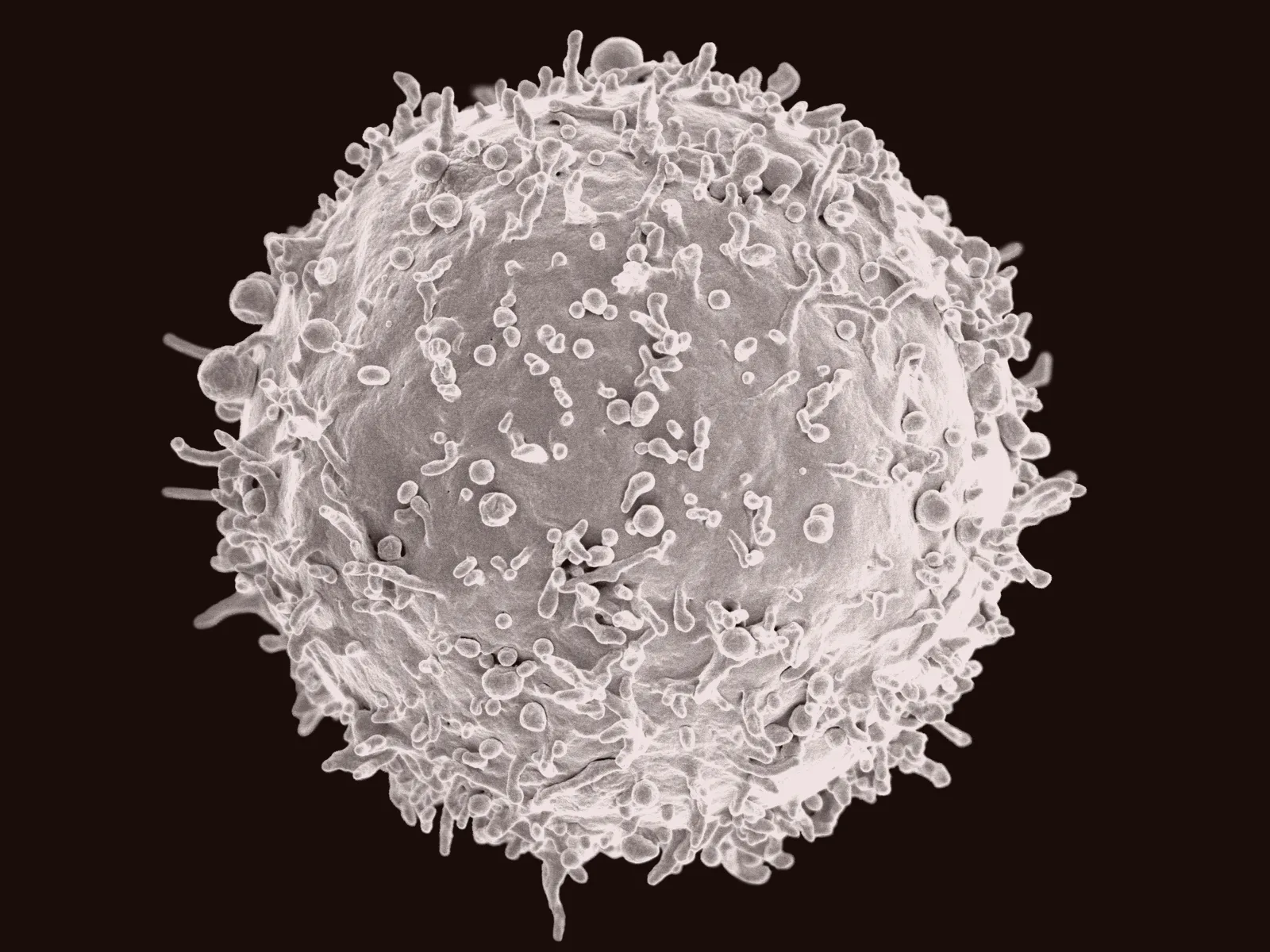
See the five architecture decisions ↓Illustrative SEM: human B lymphocyte. Not a Driessen-Kerr product or experimental result. NIAID · CC BY 2.0 · desaturated and toned.
A health solution needs more than a molecular hypothesis: composition, production, control, transfer and evaluation criteria must work together.
Driessen-Kerr treats composition, process and evidence as connected decisions. The aim is to reduce technical risk before it becomes a scale, cost or transfer risk.
The excipient system must be compatible with the payload, method and product route.
A promising formulation advances only if it can be reproduced and transferred without losing critical attributes.
Capacity, cost, control and release must be considered before the development decision.
Driessen-Kerr's applied-science approach organizes decisions between molecular hypothesis and product: each hypothesis should inform critical attributes, composition, process, stability, release and the next assay.
The method connects science and product-engineering decisions, organizes learning across programs and provides a common basis for technical discussions with partners.
Translate biology into product attributes, testable formulations and analytical methods.
Use every result to update the next decision, not simply archive data.
Design stability, release and scale before industrial transfer.
Accumulate applied learning across mRNA, delivery, process and evidence between programs.
The platform organizes decisions that usually arrive too late: critical quality attributes, practical composition, process design, stability and release criteria. Each layer can be audited without turning a hypothesis into a result.
Five connected decisions / scope defined per application
which sequence and critical attribute define the product
which excipient system is practical
how to produce with repeatability and transfer
how to preserve integrity until release
which data allows disciplined advancement
This sequence guides technical questions; it does not certify that studies, production or transfer have been completed. The qualification route and any potential transfer are defined with each partner.
NM-mRNA names Driessen-Kerr's approach to mRNA product-system architecture. Payload, composition, process, characterization, stability and transfer are addressed together, with technical scope defined for each application.
Performance, quality and application parameters are discussed with partners according to the product, indication and relevant technical requirements.
Identity, integrity, composition, stability and function guide technical characterization. Methods and criteria depend on the payload, formulation and application under discussion.
| Attribute | Why it matters | Technical discussion |
|---|---|---|
| Identity and sequence | Confirms material matches the intended payload. | Program-specific method and result not presented; define and verify per program. |
| Payload selection | Connects the biological question to the intended product and attributes to assess. | Payload and program rationale not specified on this page; program-dependent decision. |
| Composition and compatibility | Can affect association, integrity, stability and functional performance. | Formulation and payload compatibility not demonstrated here; assess per program. |
| Process and in-process controls | Links operations and parameters to material characteristics and repeatability. | Parameters, controls and campaign data not presented; define and qualify. |
| Integrity | Assesses RNA degradation and preservation through processing and storage. | Formulation data not presented; method and limits to qualify. |
| Purity and impurities | Characterizes relevant related species and process impurities. | Panel and results not presented; define for the process. |
| Concentration | Informs content per volume and consistency across samples or batches. | Quantitative result not presented; establish method and criterion. |
| Size and distribution | Helps characterize the particle population when relevant to the formulation. | Characterization not presented; applicability and method to define. |
| Encapsulation / association | Distinguishes matrix-associated from free material, as relevant to the architecture. | Efficiency not demonstrated on this page; method and criterion per formulation. |
| Potency / function | Assesses measurable biological activity in an appropriate assay. | Assay and functional data not presented; define model and endpoint. |
| Microbial controls and endotoxins | Supports assessment of microbiological quality and product safety. | Limits and batch results not presented; requirements depend on product route. |
| Stability | Determines changes over time under defined conditions. | Profile and shelf life not established here; product-specific study needed. |
| Packaging and storage | Conditions can affect protection, handling and shelf life. | Configuration and conditions are not specified as qualified; define and assess per product. |
Confirms material matches the intended payload.
Technical discussionProgram-specific method and result not presented; define and verify per program.
Connects the biological question to the intended product and attributes to assess.
Technical discussionPayload and program rationale not specified on this page; program-dependent decision.
Can affect association, integrity, stability and functional performance.
Technical discussionFormulation and payload compatibility not demonstrated here; assess per program.
Links operations and parameters to material characteristics and repeatability.
Technical discussionParameters, controls and campaign data not presented; define and qualify.
Assesses RNA degradation and preservation through processing and storage.
Technical discussionFormulation data not presented; method and limits to qualify.
Characterizes relevant related species and process impurities.
Technical discussionPanel and results not presented; define for the process.
Informs content per volume and consistency across samples or batches.
Technical discussionQuantitative result not presented; establish method and criterion.
Helps characterize the particle population when relevant to the formulation.
Technical discussionCharacterization not presented; applicability and method to define.
Distinguishes matrix-associated from free material, as relevant to the architecture.
Technical discussionEfficiency not demonstrated on this page; method and criterion per formulation.
Assesses measurable biological activity in an appropriate assay.
Technical discussionAssay and functional data not presented; define model and endpoint.
Supports assessment of microbiological quality and product safety.
Technical discussionLimits and batch results not presented; requirements depend on product route.
Determines changes over time under defined conditions.
Technical discussionProfile and shelf life not established here; product-specific study needed.
Conditions can affect protection, handling and shelf life.
Technical discussionConfiguration and conditions are not specified as qualified; define and assess per product.
The approach considers process, materials, yield, controls and transfer from the outset. Capacity and performance are assessed for each product with qualified facilities, partners and production runs.
Access goals guide the design; cost per dose is determined by each product's yield, inputs, capacity, controls, packaging and logistics.
Define input specifications, unit operations and process dependencies.
Identify critical parameters and in-process controls linked to target attributes.
Develop fit-for-purpose methods, acceptance criteria and a release strategy.
Assess effects of scale, equipment, site and batch changes using comparable data.
A transfer discussion starts with the application, quality requirements and relevant evidence. Access to technical materials and confidentiality terms are aligned with scope and availability.
Indication, target product profile, intended payload, scope and decision criteria.
Where needed, establish confidentiality and identify available, authorized materials for sharing.
Review capacity, equipment, controls and requirements relevant to the process.
Translate requirements into instructions, parameters and controls suitable for the selected site.
Plan execution and document deviations, sampling and process results.
Assess defined attributes and comparability to reference material, where available.
Use results to decide whether to repeat, adjust, expand studies or stop the route.
The NM-mRNA approach connects payload, composition, stability, analytical methods and transfer within one product architecture. Technical scope and evaluation criteria are defined with each partner.
Expanding access guides decisions about process, transfer and cost per dose. Specific capacity and conditions are addressed in institutional conversations for each program.
The nutrigenomic program and mRNA product systems address different applications. Each program organizes its own composition, biological context and technical criteria, without confusing EPITIDE™ with an mRNA-containing product.
Composition, biomarkers and endpoints guide the discussion of nutrigenomic applications.
A precision nutrition surface used to learn about composition, adherence, ingredient documentation and use context — without taking the place of mRNA technology.
Integrates product data, functional assays, biomarkers and endpoints into program-specific decisions.
From product design to regulatory strategy, the approach connects the technical considerations a partner needs to discuss for its application. Data sharing and diligence scope are handled individually.
Connect application, payload, composition and critical attributes.
Select methods and criteria for identity, integrity, purity, concentration and applicable attributes.
Define an assay, model and endpoint to test the intended product function.
Where justified, plan model, design, comparators and criteria before execution.
Relate conditions, packaging and criteria to the product.
Align process criteria, comparability and partners.
Consider the product, indication, population and relevant evidence.
Map requirements relevant to the jurisdiction and intended use.
These items guide application-specific diligence; shareable documents depend on scope and available materials.
More discipline for connecting product architecture, assay and development decision.
An mRNA thesis that considers composition, process and transfer before committing scale capital.
Diligence criteria that make technical risk, industrial readiness and the next milestone more legible.
Research, development, manufacturing and strategic-capital partners can explore NM-mRNA applications in a technical conversation. Scope, shareable materials and collaboration criteria are defined case by case. This pathway is separate from EPITIDE™.
Potential collaboration to define critical attributes, composition, analytical methods and process requirements for a product, indication and jurisdiction.
Any potential transfer would require an assessed partner and site, process adaptation, an engineering batch, comparability, quality controls and applicable regulatory requirements.