01 · HYP
Particle size & distribution
Measure size using a defined method and conditions; determine whether a reproducible vesicle/particle population exists.
Is there a defined, reproducible dispersed system?
A map of ingredient-level mechanisms, published evidence, and open product questions. Literature is distinguished from evidence still needed for the DK-7.4 formulation.
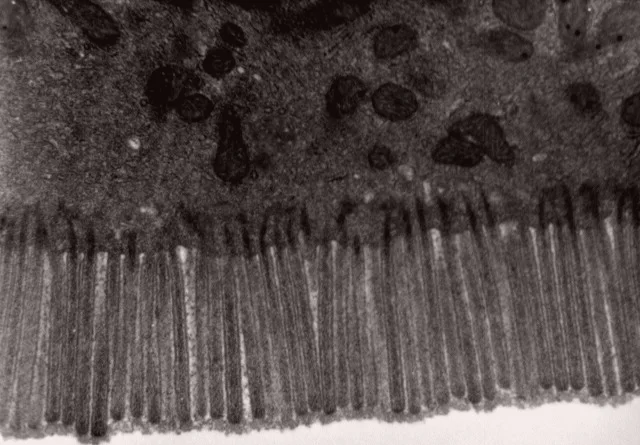
Illustrative TEM: microvilli of a human intestinal cell. Not DK-7.4 experimental data. Louisa Howard & Katherine Connollly · public domain · cropped, toned.
During an energy deficit, the energy sensor AMPK can inhibit mTORC1 through TSC1/TSC2 in context-dependent energy signaling; links to protein synthesis and ubiquitin–proteasome activity depend on model and conditions.
Ingredient literature describes pathways such as PI3K/Akt and mTORC1 in specific models. Any link to DK-7.4 remains a formulation hypothesis until composition, exposure, and a suitable response are measured.
The relationship among these pathways, nutritional exposure, and human outcomes must be measured directly. Ingredient literature is not evidence of efficacy or superiority for the product.
LIT · Leucine is a nutrient signal; response is context-dependent. No universal 2.5 g threshold, product exposure, or plateau is established here.
Leucine is a branched-chain amino acid whose nutrient-sensing relationship with mTORC1via protein Ragulator and complex GATOR2 is described in mechanistic literature. It does not define a universal dose threshold: Wilkinson et al. report no leucine threshold in older adults, and response varies with population, meal, protein, and exercise.
The cited Wolfe 1982 paper does not establish the previously stated 45–55% splanchnic extraction, nor does it compare conventional protein with this matrix. It cannot be used to calculate an “effective” leucine dose.
HYP · Whether the DK-7.4 phospholipid matrix changes digestion, absorption, systemic exposure, or a downstream marker is an open test question. No encapsulation or delivery advantage is inferred.
DK-7.4 is described as a phospholipid-powder matrix involving phosphatidylcholine (PC) and phosphatidylserine (PS). The rationale is that phospholipids may organize a matrix; vesicles, encapsulation, stability, and delivery are formulation hypotheses—not established product attributes.
Phospholipids can form bilayers in suitable systems. Whether this powder forms vesicles or protects amino acids under gastric conditions must be measured; no acid-resistance result is claimed.
Lymphatic uptake, systemic appearance, and metabolism are uncharacterized for this formulation. Do not infer lymphatic transport, avoidance of first-pass metabolism, or circulating intact leucine.
Vesicle–cell fusion and intracellular release are not shown for DK-7.4. The cited Wolfe 1982 study does not support a liposomal advantage; cellular delivery would require direct evidence.
Conceptual matrix · not evidence of vesicles, encapsulation, or delivery.
These are proposed characterization questions, not reported DK-7.4 results. Acceptance criteria and methods should be defined before testing.
Measure size using a defined method and conditions; determine whether a reproducible vesicle/particle population exists.
Is there a defined, reproducible dispersed system?
Determine polydispersity index and method suitability across independent preparations.
Is distribution sufficiently controlled for the intended use?
Characterize surface-charge measurement with medium, dilution, and method recorded.
Does the result support a stability hypothesis under specified conditions?
Use a validated separation and quantification method for each relevant payload; distinguish encapsulated from free fraction.
Is component association demonstrated and reproducible?
Track size, PDI, zeta, leakage/degradation, appearance, and relevant assays over defined storage and stress conditions.
What storage conditions and shelf-life are supportable?
Use suitable microscopy to assess morphology; only then design comparative digestion/bioavailability or pharmacokinetic work with prespecified endpoints.
Do not infer absorption or systemic exposure from morphology or encapsulation alone.
In studied models, mTORC1-mediated phosphorylation of S6K1 at Thr389 is linked to downstream substrates including rpS6 and eIF4B and regulation of translation. This pathway description does not establish a product response.
4E-BP1 can bind eIF4E and regulate cap-dependent translation; mTORC1-associated phosphorylation releases this interaction in studied systems. Model-specific mechanism, not a human outcome.
Ely et al. (2023) review nutrient regulation in aging, exercise, and unloading contexts. It does not establish a universal 2.5 g threshold or a threefold product effect. Wilkinson et al. (2023) report no leucine threshold in older adults. DOI: 10.1016/j.clnu.2023.08.010; 10.14814/phy2.15775.
Li et al. (2025): pooled lean-mass estimate from 21 RCTs, n=1,935 participants over 50 years. Appendicular lean mass estimate: +1.56 kg. These estimates concern oral HMB in the included studies only; protocols varied and neither estimate predicts DK-7.4 outcomes. DOI: 10.3389/fnut.2025.1522287.
Welch et al. (2023) reviewed seven randomized trials of phosphatidylserine in sport; evidence was considered insufficient for firm endorsement. The review does not support a ~30% cortisol-reduction claim or an effect of this product. DOI: 10.33545/27077012.2023.v4.i2c.209.
Regulatory context: RDC 18/2010 was revoked by RDC 243/2018. Brazilian review considers RDC 243/2018, IN 28/2018 as amended, RDC 843/2024, IN 281/2024 and other applicable rules. Product classification, claims and labeling depend on final composition and intended use; this page presents no documentation establishing notification or registration. Ingredient literature is not clinical evidence for the complete formulation.
Access the technical documentation to review ingredient literature, declared composition, and the boundary between published mechanisms and evidence that still needs to be generated for the formulation.
Access Medical Portal →Bibliographic DOI records have been checked. Each study's design, population and endpoint constrain the interpretation; a valid DOI does not verify the site's numerical claims or establish a result for DK-7.4.
Ely IA, Phillips BE, Smith K, Wilkinson DJ, Piasecki M, Breen L, Larsen MS, Atherton PJ.
A focus on leucine in the nutritional regulation of human skeletal muscle metabolism in ageing, exercise and unloading states.
Li N, Wu X, Zhuang W, et al.
Effects of oral supplementation of β-hydroxy-β-methylbutyrate on muscle mass and strength in individuals over the age of 50: a meta-analysis.
Welch J, Bashir H, Daniels S.
The effect of phosphatidylserine supplementation on athletic performance: A systematic review of randomized clinical trials.
D'Hulst G, De Bock K.
Resistance exercise enhances long-term mTORC1 sensitivity to leucine.
Wilkinson K, Koscien CP, Monteyne AJ, Wall BT, Stephens FB.
Association of postprandial postexercise muscle protein synthesis rates with dietary leucine: A systematic review.
Jewell JL, Kim YC, Russell RC, Yu FX, Park HW, Plouffe SW, Tagliabracci VS, Guan KL.
Differential regulation of mTORC1 by leucine and glutamine.
Kreider RB, Kalman DS, Antonio J, Ziegenfuss TN, Wildman R, Collins R, Candow DG, Kleiner SM, Almada AL, Lopez HL.
International Society of Sports Nutrition position stand: safety and efficacy of creatine supplementation in exercise, sport, and medicine.
Wolfe RR, Goodenough RD, Wolfe MH, Royle GT, Nadel ER.
Isotopic analysis of leucine and urea metabolism in exercising humans.
References concern published ingredient literature, not studies of the complete formulation. Classification, authorized constituents, claims and notification of any finished supplement require review against current Brazilian rules and product documents.